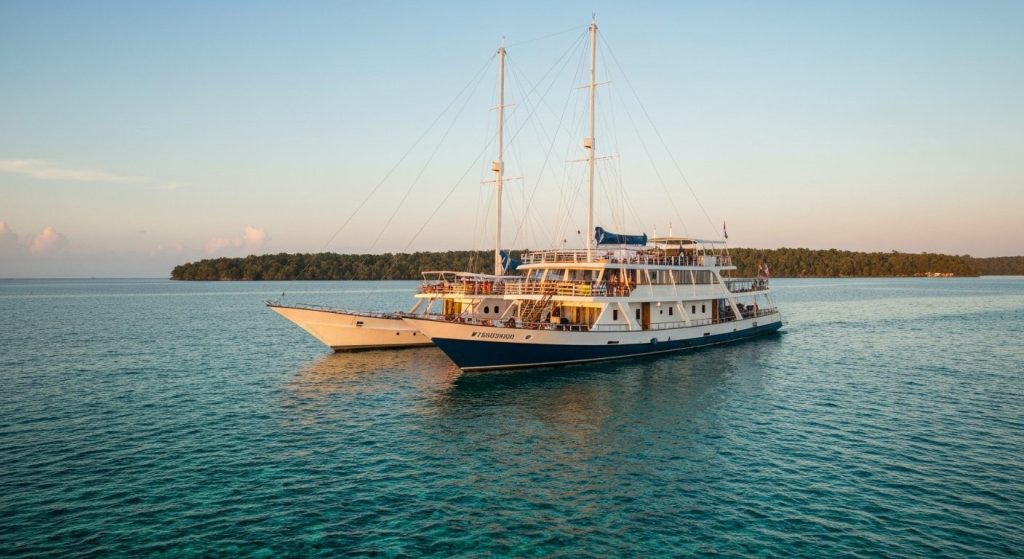
A Misool Wayag Piaynemo yacht expedition is a multi-day private crewed voyage that links Raja Ampat’s three signature regions, Misool in the far south, Wayag in the far north, and the Piaynemo viewpoint in the central reaches, into one continuous route aboard a single yacht or phinisi. Because these sites sit hundreds of kilometres apart across open water, a self-contained vessel that sails overnight is the practical way to reach all of them in comfort. I am Daniel Sorongan, a Papua-based divemaster, and this guide maps what each region offers and how a charter stitches them together.
The short version: you do not pick one. You sail through all of them.
Land-based stays box you in. From a fixed resort near Waisai you might reach Cape Kri or Manta Sandy on a day boat, but Wayag’s karst maze and Misool’s soft-coral walls stay out of range. A yacht moves while you sleep, so you wake up already anchored at the next site. That is the whole logic of the expedition format, and it is why we built our crewed fleet at private crewed luxury yacht charter across Raja Ampat around long, far-reaching routes rather than short hops.
The three marquee regions, and what each one is for
Raja Ampat is enormous. Four main island groups, more than 1,500 smaller islands, and dive sites scattered across a marine area roughly the size of a small country. Trying to describe it as one place is a mistake. Each region has its own character, its own water, its own reason to go.
Misool: the soft-coral south
Misool sits in the deep south, the most remote corner of the archipelago and, for many divers, the richest. The reefs here are carpeted in soft coral in colours that look almost artificial, reds, oranges, purples, fanning out in the current. This is also where you find the famous limestone lagoons and the hand stencils painted on cliff walls thousands of years ago.
Misool is far. From Sorong it is an overnight sail, sometimes longer depending on weather and route. That distance is exactly why a liveaboard yacht makes sense: there is no comfortable way to reach southern Misool on a day trip from anywhere. You sail in, you stay several nights, you dive the sanctuary sites, then you sail on. For divers and underwater photographers, Misool is often the highlight of the entire voyage.
Wayag: the karst-island north
If you have seen one image of Raja Ampat, it was probably Wayag. Beehive-shaped limestone islets rising straight out of turquoise water, viewed from a climb up a jagged peak. Wayag sits in the far north, again an overnight sail from the central hub, and again best reached by a vessel that carries you there and waits.
Wayag is less about deep diving and more about the surface world: kayaking through the karst channels, snorkelling over shallow coral gardens, climbing for the panorama, and drifting between islets in glassy lagoons. The Wayag & Piaynemo Karst Islands Guide (Viewpoints, Kayaking & Snorkeling) goes deep on the climbs and the lagoon routes if you want the detail. From the deck of an anchored yacht at dawn, before any other boat arrives, Wayag is as quiet as the region gets.
Piaynemo: the central star lagoon
Piaynemo is the postcard you can actually reach in a morning. A boardwalk and staircase climb to a viewpoint over a cluster of mushroom islets and a small lagoon shaped, from above, a little like a star. It sits more centrally than Misool or Wayag, so it often slots into a route as a half-day stop between the bigger crossings.
Around Piaynemo the snorkelling is gentle and the water clear, which makes it a favourite for families and mixed-ability groups where not everyone dives. Climb the viewpoint at first light, snorkel the shallows after, and you have a full morning before lunch back on board.
The signature dive and snorkel sites along the way
Between the three big regions sits the central engine room of Raja Ampat diving, the Dampier Strait and its neighbours. These are the sites that put the region on every serious diver’s list. Our Raja Ampat dive and snorkel yacht expeditions are built to slot these in around the crossings.
- Cape Kri — On the eastern tip of Kri Island in the Dampier Strait. Cape Kri holds a long-standing reputation for one of the highest single-dive fish counts ever recorded. Schooling fish, sharks, and current-fed action. Strong drift on the big tides, so dives are timed to the water, not the clock. It also snorkels well on the shallow shoulder, which is why I flag it as a Cape Kri snorkel site for non-divers too.
- Manta Sandy — A cleaning station in the Dampier Strait where reef mantas queue up over a sandy patch to be cleaned. Sit behind the marked line, stay still, and let them come to you. Sightings are seasonal and never guaranteed, but when the mantas are in, it is the encounter people travel across the planet for.
- Dampier Strait — The channel between Waigeo and Batanta that funnels nutrient-rich current across dozens of reefs. This is the central spine most routes return to, and the strait that connects the northern and southern legs of an expedition.
- Batanta detours — The island south of the strait adds muck-dive and macro sites, plus a couple of small waterfalls reachable by tender. A good change of pace between high-current reef days.
One honest note from a divemaster: Manta sightings, visibility numbers, and current strength all shift week to week. I sense-check every site against current conditions before we run it, and serious dive-qualification questions, certification levels, nitrox, medical fitness, should go to your dive instructor or the onboard dive guide, not a web page. This is destination information, not professional dive, medical, or safety advice.
How a multi-day charter stitches it together
The art of the expedition is sequencing. You cannot hit Misool and Wayag on the same short trip, they sit at opposite ends, so route length decides how much you see. Here is the practical map of what fits into what.
| Charter length | Realistic regions covered | Best suited to |
|---|---|---|
| 4–5 days | Central hub: Dampier Strait, Cape Kri, Manta Sandy, Piaynemo | First-timers, shorter holidays, families |
| 6–7 days | Central hub plus EITHER Misool OR Wayag | Divers wanting one remote region in depth |
| 8–10 days | Misool, central hub, Piaynemo AND Wayag in one loop | Expedition travellers, photographers, the full voyage |
| 11+ days | Above plus extended Misool sanctuary time and slower pacing | Repeat visitors, charters chasing specific conditions |
Most guests who want both Misool and Wayag on one trip choose a route of 8 to 10 days. Anything shorter and you are choosing one end of the archipelago. Our full route logic, broken down day by day, lives in the Raja Ampat yacht itinerary guide if you want to see how the legs connect.
A few planning realities I always raise with guests:
- Overnight crossings are the engine. The long sails between regions happen while you sleep, so daylight stays reserved for diving, snorkelling, kayaking, and viewpoints.
- Weather windows shape the route. Market guidance from regional operators points to calmer conditions roughly October through April, with year-round options depending on vessel and route. The captain may flip the order of legs to chase the calmer water.
- Marine park permits are practical, not optional. Entry permits and dive tags are required and are usually arranged by the operator. Treat any fee figure as informational and verify current rules with the authorities.
Want a route shaped around your dates and your group? Plan your trip with our team, or send a quick message over WhatsApp and we will sketch a draft itinerary, no obligation.
Vessel choice: phinisi or motor yacht for the expedition
The two main vessel styles change the feel of the same route. A traditional wooden phinisi has the romance, the deck space, and the sailing character; a motor yacht trades some of that for speed and a different ride on the crossings. We genuinely operate our own crewed fleet for these expeditions, and certain larger motor yachts and superyachts come through vetted partner operators, which we disclose plainly. If a guest proceeds on a partner vessel, that partner may pay us a referral fee at no extra cost to you.
| Vessel style | Typical guests | Indicative rate (varies by season & vessel) | Best for this expedition |
|---|---|---|---|
| Classic / smaller phinisi | 2–10 guests | ~US$1,900–3,500 per night | Couples and small groups, sailing character |
| Premium / luxury yacht | 2–14 guests | ~US$4,500–9,000+ per night | Comfort-led charters, longer remote routes |
| Large motor yacht / superyacht (via partners) | up to ~12–16 guests | ~US$9,000–15,000+ per day | UHNW groups, range and onboard amenities |
Those figures are indicative market ranges, drawn from across the Raja Ampat charter sector, not a fixed quote. The real number moves with vessel size, season, cabin count, and what is included. For the full picture see our Raja Ampat yacht charter cost and cabin classes breakdown, and if you are weighing the two boat types, the traditional crewed phinisi charter page lays out the case for wooden sailing vessels.
To translate per-night rates into a per-person sense: a typical premium expedition often lands somewhere around US$4,000–8,000 per person for a multi-day full-vessel charter shared among a group, again varying widely by season and route. Always indicative, never guaranteed.
Capacity and duration at a glance
- Cabins: most expedition vessels sleep 2 to 14 guests across private cabins.
- Duration: expeditions run from 4 to 10+ days; the full Misool-plus-Wayag loop wants 8 to 10.
- Crew: captain, chef, dive guides, and deck crew live aboard so the vessel is self-sufficient between ports.
- Departure points: most voyages start and end at Sorong, with some routing through Waisai.
Choosing the right format for your group
Not everyone on board will dive, and that is fine, the best expeditions are built so divers and non-divers both have a full day. If you are unsure whether a full charter, a liveaboard, or a per-cabin booking suits you, the comparison of a multi-day private liveaboard yacht charter against the alternatives is the place to start.
- Couples often pair a Misool-heavy route with the privacy of a smaller vessel, the logic behind our raja ampat honeymoon yacht charter.
- Families and mixed groups lean toward central routes with Piaynemo and gentle snorkelling, covered on the family yacht charter raja ampat page.
- Serious divers and photographers push for the long loop, more Misool sanctuary days, more time on the cleaning stations.
When to go
Timing matters more here than almost anywhere I have guided. The calmer-water months make the long crossings to Misool and Wayag noticeably more comfortable, and manta activity has its own seasonal rhythm. Rather than commit a date before you understand the trade-offs, read the best time to charter a yacht in Raja Ampat guide first. Weather, visibility, and wildlife are always presented as likely, never promised, the ocean does not sign contracts.
How to start planning your expedition
Putting a Misool, Wayag, and Piaynemo voyage together is mostly about three decisions: how many days you have, which vessel fits your group, and which season suits your priorities. Get those three right and the route almost designs itself. The step-by-step in how to charter a luxury yacht in Raja Ampat walks through it, and the frequently asked questions page answers the practical details, permits, transfers, what is included.
Ready to map your own route through the karst islands and the soft-coral south? Plan your trip and tell us your dates, group size, and whether diving leads the trip. Message us on WhatsApp for a fast reply, and we will draft an expedition itinerary built around your voyage, with honest pricing and clear disclosure of which legs run on our own fleet and which on vetted partners.
This page is destination and planning information, not professional dive, medical, insurance, or legal advice. Marine park permit details are practical guidance, not an official guarantee, please confirm current requirements with the relevant authorities, and route dive-qualification and health questions to your instructor, doctor, or licensed insurer.